
Why Spring?
- It is the most popular application development framework for enterprise Java to create high performing, easily testable, and reusable code.
- Spring framework is an open source Java platform. It was initially written by Rod Johnson and was first released under the Apache 2.0 license in June 2003.
- Spring is lightweight when it comes to size and transparency. The basic version of Spring framework is around 2MB.
- The core features of the Spring Framework can be used in developing any Java application, but there are extensions for building web applications on top of the Java EE platform. Spring framework helps to make J2EE development easier to use and promotes good programming practices by enabling a POJO-based programming model.
Why to use Spring?
Few of the great benefits of using Spring Framework are as below:
- POJO (Plain Old Java Object) Based – Spring enables developers to develop enterprise-class applications using POJOs. The benefit of using only POJOs is that you do not need an EJB container product such as an application server but you have the option of using only a robust servlet container such as Tomcat or some commercial product.
- Modular – Spring is organized in a modular fashion. Even though the number of packages and classes are substantial, you have to worry only about the ones you need and ignore the rest.
- Integration with existing frameworks – Spring does not reinvent the wheel, instead it truly makes use of some of the existing technologies like several ORM frameworks, logging frameworks, JEE, Quartz and JDK timers, and other view technologies.
- Testability – Testing an application written with Spring is simple because environment-dependent code is moved into this framework. Furthermore, by using JavaBean style POJOs, it becomes easier to use dependency injection for injecting test data.
- Web MVC – Spring’s web framework is a well-designed web MVC framework, which provides a great alternative to web frameworks such as Struts or other over-engineered or less popular web frameworks.
- Central Exception Handling – Spring provides a convenient API to translate technology-specific exceptions (thrown by JDBC, Hibernate, or JDO, for example) into consistent, unchecked exceptions.
- Lightweight – Lightweight IoC containers tend to be lightweight, especially when compared to EJB containers, for example. This is beneficial for developing and deploying applications on computers with limited memory and CPU resources.
- Transaction management – Spring provides a consistent transaction management interface that can scale down to a local transaction (using a single database, for example) and scale up to global transactions (using JTA, for example).
Dependency Injection (DI)
The technology that Spring is most identified with is the Dependency Injection (DI) flavor of Inversion of Control. The Inversion of Control (IoC) is a general concept, and it can be expressed in many different ways. Dependency Injection is merely one concrete example of Inversion of Control.
When writing a complex Java application, application classes should be as independent as possible of other Java classes to increase the possibility to reuse these classes and to test them independently of other classes while unit testing. Dependency Injection helps in gluing these classes together and at the same time keeping them independent.
What is dependency injection exactly? Let’s look at these two words separately. Here, the dependency part translates into an association between two classes. For example, class A is dependent of class B. Now, let’s look at the second part, injection. All this means is, class B will get injected into class A by the IoC.
Dependency injection can happen in the way of passing parameters to the constructor or by post-construction using setter methods.
Aspect Oriented Programming (AOP)
One of the key components of Spring is the Aspect Oriented Programming (AOP) framework. The functions that span multiple points of an application are called cross-cutting concerns and these cross-cutting concerns are conceptually separate from the application’s business logic. There are various common good examples of aspects including logging, declarative transactions, security, caching, etc.
The key unit of modularity in OOP is the class, whereas in AOP the unit of modularity is the aspect. DI helps you decouple your application objects from each other, while AOP helps you decouple cross-cutting concerns from the objects that they affect.
The AOP module of Spring Framework provides an aspect-oriented programming implementation allowing you to define method-interceptors and pointcuts to cleanly decouple code that implements functionality that should be separated.
Spring Framework
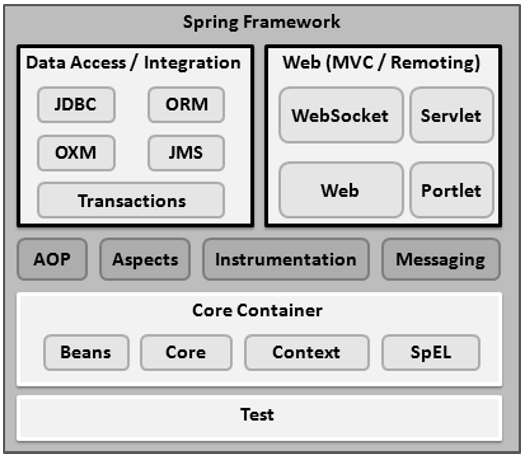
The Spring Framework provides about 20 modules which can be used based on an application requirement.
Core Container
The Core Container consists of the Core, Beans, Context, and Expression Language modules the details of which are as follows −
- The Core module provides the fundamental parts of the framework, including the IoC and Dependency Injection features.
- The Bean module provides BeanFactory, which is a sophisticated implementation of the factory pattern.
- The Context module builds on the solid base provided by the Core and Beans modules and it is a medium to access any objects defined and configured. The ApplicationContext interface is the focal point of the Context module.
- The SpEL module provides a powerful expression language for querying and manipulating an object graph at runtime.
Data Access/Integration
The Data Access/Integration layer consists of the JDBC, ORM, OXM, JMS and Transaction modules whose detail is as follows −
- The JDBC module provides a JDBC-abstraction layer that removes the need for tedious JDBC related coding.
- The ORM module provides integration layers for popular object-relational mapping APIs, including JPA, JDO, Hibernate, and iBatis.
- The OXM module provides an abstraction layer that supports Object/XML mapping implementations for JAXB, Castor, XMLBeans, JiBX and XStream.
- The Java Messaging Service JMS module contains features for producing and consuming messages.
- The Transaction module supports programmatic and declarative transaction management for classes that implement special interfaces and for all your POJOs.
Web
The Web layer consists of the Web, Web-MVC, Web-Socket, and Web-Portlet modules the details of which are as follows −
- The Web module provides basic web-oriented integration features such as multipart file-upload functionality and the initialization of the IoC container using servlet listeners and a web-oriented application context.
- The Web-MVC module contains Spring’s Model-View-Controller (MVC) implementation for web applications.
- The Web-Socket module provides support for WebSocket-based, two-way communication between the client and the server in web applications.
- The Web-Portlet module provides the MVC implementation to be used in a portlet environment and mirrors the functionality of Web-Servlet module.
Miscellaneous
There are few other important modules like AOP, Aspects, Instrumentation, Web and Test modules the details of which are as follows −
- The AOP module provides an aspect-oriented programming implementation allowing you to define method-interceptors and pointcuts to cleanly decouple code that implements functionality that should be separated.
- The Aspects module provides integration with AspectJ, which is again a powerful and mature AOP framework.
- The Instrumentation module provides class instrumentation support and class loader implementations to be used in certain application servers.
- The Messaging module provides support for STOMP as the WebSocket sub-protocol to use in applications. It also supports an annotation programming model for routing and processing STOMP messages from WebSocket clients.
- The Test module supports the testing of Spring components with JUnit or TestNG frameworks.
Spring Configuration
Spring IoC container is totally decoupled from the format in which this configuration metadata is actually written. Following are the three important methods to provide configuration metadata to the Spring Container −
- XML based configuration file (using Spring bean configuration XML file)
- Annotation-based configuration (using <context:annotation-driven/> in the Spring bean configuration XML file)
- Java-based configuration (using @Configuration and @Bean annotations on Java classes)
Spring Bean Scopes
When defining a <bean> you have the option of declaring a scope for that bean. For example, to force Spring to produce a new bean instance each time one is needed, you should declare the bean’s scope attribute to be prototype. Similarly, if you want Spring to return the same bean instance each time one is needed, you should declare the bean’s scope attribute to be singleton.
The Spring Framework supports the following five scopes, three of which are available only if you use a web-aware ApplicationContext.
| Sr.No. | Scope & Description |
|---|---|
| 1 | singleton This scopes the bean definition to a single instance per Spring IoC container (default). |
| 2 | prototype This scopes a single bean definition to have any number of object instances. |
| 3 | request This scopes a bean definition to an HTTP request. Only valid in the context of a web-aware Spring ApplicationContext. |
| 4 | session This scopes a bean definition to an HTTP session. Only valid in the context of a web-aware Spring ApplicationContext. |
| 5 | global-session This scopes a bean definition to a global HTTP session. Only valid in the context of a web-aware Spring ApplicationContext. |
The default scope is always singleton.
Example of configuring bean scope in XML-based ApplicationContext is as below.
<!-- A bean definition with singleton scope -->
<bean id = "..." class = "..." scope = "singleton">
   <!-- collaborators and configuration for this bean go here -->
</bean> Beginner's Luck